

A dealer who supplies only broadloom carpet, uses “commercial grade” as a specification, or leaves moisture testing and spare tiles out of the quote can create expensive problems after installation. By checking the product evidence, site process, supply continuity and lifecycle trade-offs, you can compare dealers on performance rather than a sample or price per square metre.
Key takeaways
- Request the exact product code, technical sheet and modular tile specifications.
- Match fibre, construction and traffic rating to each room’s use.
- Test samples and confirm the dealer’s proposed installation method before ordering.
- Check quantities, replacement stock, maintenance duties and whole-life flooring costs.
Confirm the dealer stocks genuine modular carpet tiles and documented specifications
A genuine modular carpet tiles proposal starts with the manufacturer’s technical sheet for the exact tile, not a broadloom carpet recommendation cut into samples. Confirm that the dealer stocks modular carpet tiles and can identify the product code, rather than relying on “commercial grade” or face weight.
Request these commercial carpet tile specifications in writing:
- Fibre type, pile construction, tuft density, backing system, tile dimensions and total thickness
- Dimensional stability, electrostatic-performance data and the full warranty
- Documented use classification: EN 1307 Class 31 for moderate commercial use, EN 1307 Class 32 for general commercial use or Class 33 carpet tiles for heavy commercial use
- Intended traffic level and every warranty condition
- Castor-chair approval or test evidence for the exact tile and backing when offices use wheeled chairs
- Fire evidence for the complete flooring assembly: ASTM E648 covers critical radiant flux, while ASTM E662 covers smoke generation
- Confirmation that fire testing includes the adhesive and substrate, where applicable
Two tiles with similar face weights can perform very differently because their fibres, construction and backing differ. A dealer who cannot provide these documents is asking you to buy on appearance alone.
Also ask which pressure-sensitive adhesive or tackifier and installation method the manufacturer approves; a substitute can cause slippage, bubbling, residue transfer and difficult tile replacement.
Match fibre, construction and traffic performance to each area
Face weight alone does not predict performance: compare fibre, pile construction, tuft density, backing, total thickness, edge integrity and documented traffic classification.
| Area | Suitable construction | Checks before approval |
|---|---|---|
| Offices | Solution-dyed nylon with dense, resilient pile and castor-chair approval | Confirm the exact tile and backing are approved for continuous wheeled-chair movement |
| Retail areas | Solution-dyed nylon or robust yarn-dyed nylon with compression recovery | Check soil release, colourfastness, edge integrity and EN 1307 Class 32 or 33 |
| Hotels | Resilient, stain-releasing construction matched to lobby, room or corridor traffic | Review appearance retention, seam visibility and cleaning instructions |
| Corridors | Dense pile with strong compression recovery and heavy-traffic classification | Check edge integrity, tracked-soil performance and replacement availability |
| Classrooms | Durable, cleanable pile with suitable acoustic backing | Confirm approved cleaning chemicals and acoustic performance |
| Healthcare spaces | Low-shedding, cleanable construction compatible with rolling loads | Obtain chemical compatibility, infection-control and maintenance documentation |
| Entrances | Prefer a separate hard-wearing entry system with effective matting | Protect carpet from grit, moisture and concentrated traffic |
Solution-dyed nylon offers colour retention, stain resistance and resilience for demanding traffic and repeated cleaning. Yarn-dyed nylon provides broad colour and pattern choices, but verify fading and stain-treatment performance. Polypropylene carpet tiles suit lower-cost, stain-focused areas but lose resilience faster under concentrated traffic and chair movement.
Wool offers a premium natural appearance at higher cost, with more careful cleaning and different moisture and staining concerns. Blended fibres balance selected properties; they do not remove trade-offs.
In Jaipur, ask how monsoon moisture, dust and tracked-in grit will be controlled at entrances and near open-to-sky areas. Treat those locations as a separate surfacing specification, not as suitable merely because the label says commercial.
Inspect samples and test the proposed installation process
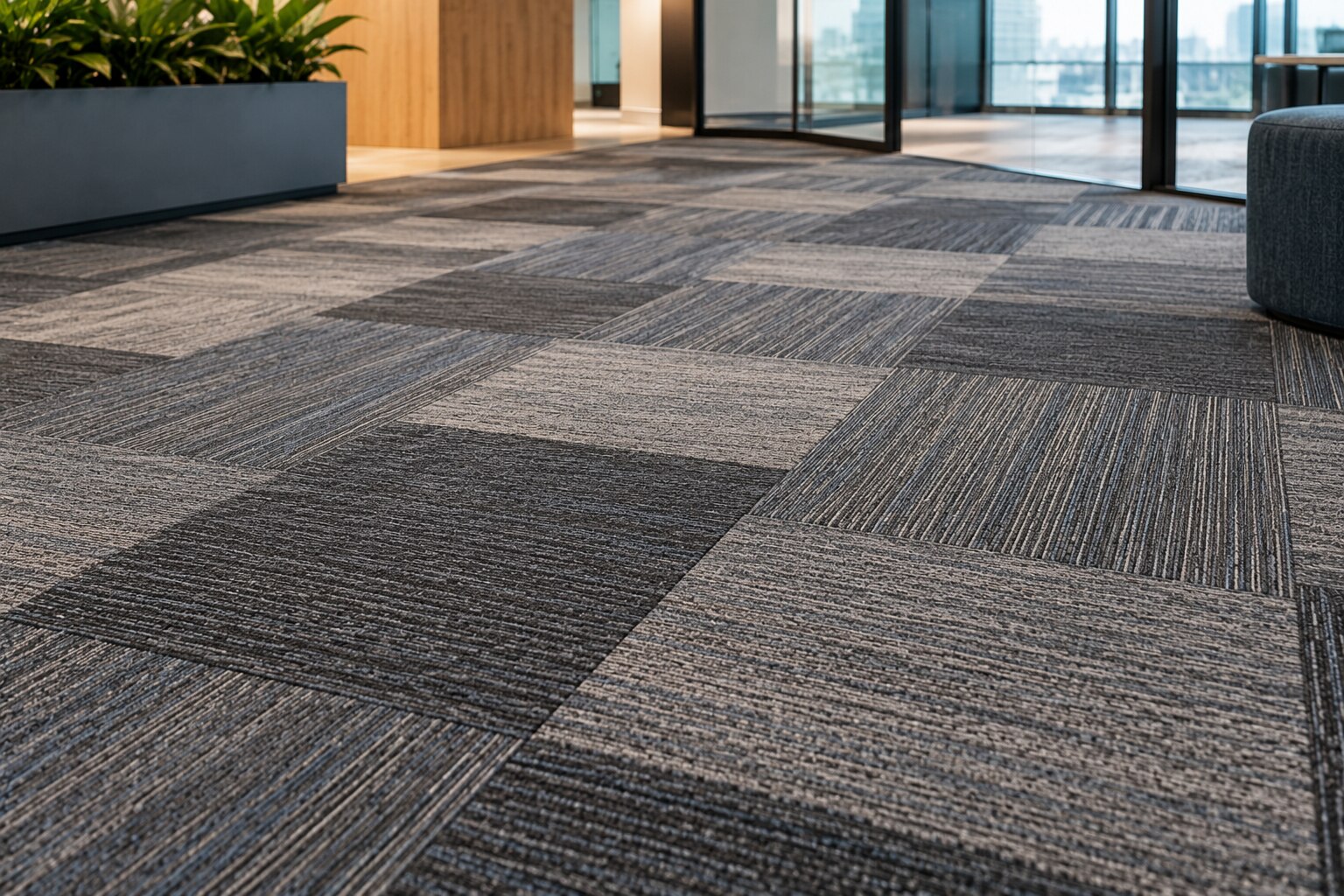
Approve a carpet tile sample only after examining several tiles under the project’s actual lighting and placing them edge to edge. Check colour variation, directional pile, pattern repeat, seam visibility, edge quality, curling, uneven corners and backing defects.
1. Ask the dealer to mark the tile orientation and installation pattern: quarter-turn, monolithic or another specified layout. Direction can create apparent colour blocks within one product range. Record the product name, colour, pattern, orientation, production lot and backing in the quote.
2. Require the quote to name the carpet tile adhesive and approved installation method. Pressure-sensitive adhesive or tackifier is common, but the correct product depends on the backing, substrate and traffic. Excess or substituted adhesive can cause slippage, bubbling, residue transfer and difficult future replacement.
3. Require ASTM F2170 in-situ relative-humidity testing or an ASTM F1869 calcium-chloride test for concrete, with the product- and adhesive-specific acceptance limit recorded. Do not accept visual dryness or slab age as proof of readiness.
Make the dealer state who pays for preparation and price it separately. Old adhesive, dust, laitance, oil, high spots and depressions can cause telegraphing, loose tiles, edge peaking or adhesive failure.
Confirm acclimatisation, temperature, humidity, ventilation and protection from wet construction before installation; wet plaster, paint or monsoon moisture can contaminate the floor and disrupt curing.
Audit the quote for quantities, supply continuity and maintenance duties
A quote supports installation, repairs and phased projects only when it separates material for immediate installation from material reserved for future use.
1. Require separate figures for measured coverage, carpet tile cutting waste and attic stock. The carpet tile quantity calculation should show how waste was derived from room layouts, thresholds, columns, pattern complexity and installation direction, not from an unexplained percentage. Spare tiles should reflect traffic, furniture movement and future product availability.
Store attic stock flat, clean and in the same environment as the installed floor.
2. Make the schedule record the exact product name, colour, pattern, tile orientation, dye lot or production lot, backing, adhesive and installation pattern. Ask whether the dealer can reserve or source the same dye lot, pattern, colour and product line for phased projects; different production lots can create visible shade variation.
Flooringworld earns confidence here only by supplying this schedule and a replacement plan, not by leaving stock as an undefined allowance.
3. Read the warranty as an installation-and-maintenance contract. Confirm in writing whether coverage requires an approved installer, named adhesive, moisture testing, regular vacuuming, approved cleaning chemicals, documented maintenance and entrance matting. Also require separate pricing and responsibility for substrate preparation.
A dirty, damp or uneven base can cause telegraphing, loose tiles, edge peaking and adhesive failure. Ask how entrances will be protected from Jaipur’s monsoon moisture, dust and tracked-in grit.
Related service
WALL TO WALL CARPET Upgrade your interiors with premium wall-to-wall carpet solutions that combine comfort, style, and durability. View service → |
Compare the tile’s lifecycle value with other commercial flooring
Choose carpet tiles when carpet tile repairability and acoustics justify their continuing maintenance, not merely when their purchase price looks low. Compare the commercial flooring lifecycle cost across the whole floor’s service period.
| Option | Lifecycle advantages | Ongoing costs or risks |
|---|---|---|
| Carpet tiles | Replace individual damaged tiles; comfortable and acoustically absorbent | Seams, vacuuming, periodic deep cleaning and spare-stock storage |
| Broadloom carpet | Fewer visible seams and a continuous pattern | Local repairs need larger cuts; matching stored material can be difficult |
| Vinyl and SPC | Spot cleaning is simple; rolling loads move easily | Less underfoot comfort and acoustic absorption; substrate preparation still matters |
| Laminate | Wood appearance at a familiar price point | Protect from moisture; wet entrances can cause swelling or edge damage |
| Hard flooring | Suits heavily soiled zones and healthcare cleaning protocols | Address slip resistance, impact noise and standing comfort |
The practical comparison is carpet tiles versus broadloom carpet for repair disruption, then carpet tiles versus vinyl and SPC for cleaning and trolley movement. Carpet tiles lose value if vacuuming is neglected or no matching attic stock remains.
Ask each dealer to price substrate preparation, adhesive, installation, cleaning, replacement stock, entrance matting and likely repair work separately. For Jaipur, keep carpet tiles indoors, protect entrances from monsoon moisture, dust and grit, and specify a different surface for open-to-sky or weather-exposed areas.
Frequently asked questions
How can you confirm that a dealer supplies genuine modular carpet tiles?
Ask for the exact product code, manufacturer’s technical sheet and proof that the product is manufactured as modular carpet tile, not broadloom carpet cut into samples. Do not accept “commercial grade” or face weight alone.
How should you match carpet tile specifications to a commercial area?
Compare fibre, carpet construction and traffic performance with each area’s use. Select specifications suited to corridors, workstations, reception areas, meeting rooms and other expected traffic levels.
What should you check before approving the installation process?
Inspect full-size samples and ask the dealer to demonstrate the proposed installation process, including tile layout, substrate preparation, adhesive or tackifier use, seams, edges and access to replacement tiles.
What should a commercial carpet tile quote include?
Check tile quantities, cutting and wastage allowances, delivery timing, product-code continuity, replacement stock, installation scope and maintenance duties. Compare the full lifecycle cost with alternatives such as broadloom carpet, vinyl and hard flooring.