

A hard, dusty or underused balcony becomes more valuable when its surface supports seating, play, pets, exercise and entertaining without creating drainage, heat or safety problems. By the end, you will know whether your space is suitable, which turf system fits it, how to plan the installation and how to maintain it in Jaipur’s weather.
Key takeaways
- Inspect load limits, waterproofing and drainage before adding turf or underlay.
- Choose UV-stable turf with suitable pile height, backing and drainage holes.
- Plan seams and cuts around drains before installation begins.
- Use a qualified installer and keep the surface clean, dry and slip-resistant.
Turn an Unused Balcony or Terrace into a Usable Outdoor Room
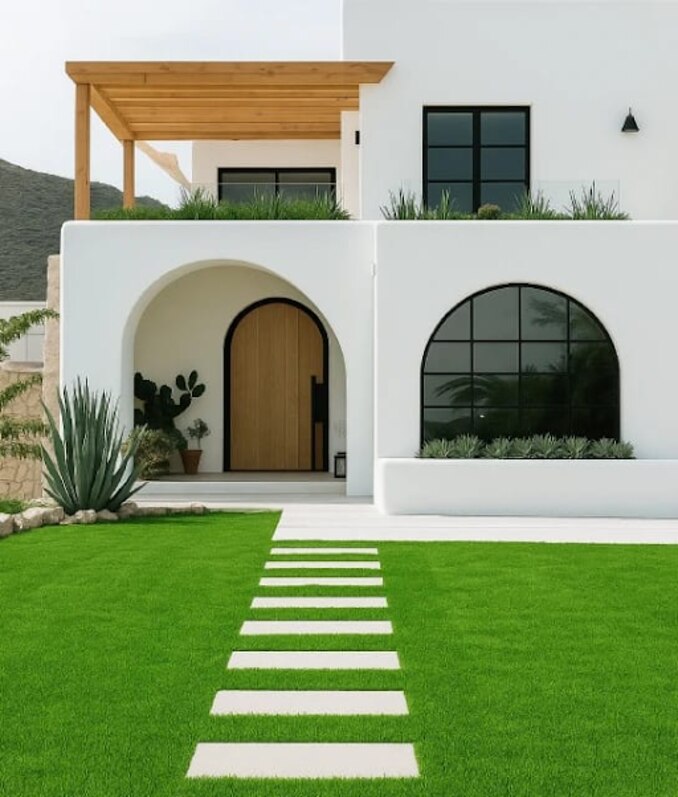
A balcony transformation works when turf turns hard, unused floor into defined zones. Use it to frame an outdoor seating area, soften a children’s play corner, give pets a more comfortable surface, or separate yoga and exercise space from dining and entertaining areas.
It also creates visual continuity with indoor rooms, but it does not create an unrestricted lawn.
Do not place artificial grass beside barbecue heat or exposed cigarette embers: heat can melt the pile and backing. Dragging furniture and dropping sharp objects can crush, cut or tear it.
| Option | Comfort and heat | Water, drainage and maintenance | Longevity and reversibility |
|---|---|---|---|
| Artificial grass | Soft underfoot, but heats in direct sun | No watering; needs a clear route to drains and regular cleaning | Durable when protected; removable if loose-laid |
| Natural grass | Cooler and softer | Uses water, needs mowing, soil depth and reliable drainage | High upkeep; difficult to reverse on balconies |
| Outdoor tiles | Firm, washable and hot in sun | Low upkeep; grout and falls must drain water | Long-lasting; usually difficult to remove cleanly |
| Decking | Warmer, forgiving underfoot | No irrigation; needs gap cleaning and drainage below | Long-lasting with care; removable by design |
| Gravel | Firm, unstable for play and furniture | Drains well but spreads into outlets | Durable; highly reversible |
| Potted plants | Adds shade and cooling, not a continuous floor | Requires watering, pruning and load capacity | Easy to rearrange; pots add weight |
| Outdoor rugs | Comfortable and cooler than bare tile | Trap moisture and require drying and cleaning | Easy to replace or remove |
Choose another surface where genuine cooling is essential, standing water persists, drainage is poor, or turf, furniture and planters could exceed the balcony’s permissible load.
Check the Balcony Before You Add Turf, Underlay or Infill
1. Inspect the terrace waterproofing membrane for blisters, cracks, open laps and damp patches before covering it. Check that the surface falls toward the drainage outlets rather than holding puddles, and inspect parapet edges, expansion joints, service covers and the door clearance.
2. Pour water into every floor outlet and watch it discharge. Do not rely on perforated turf backing: drainage mats, underlay, adhesive, dust or infill can block the route. Preserve removable access around outlets, joints and covers for cleaning and waterproofing repairs; never drill through the waterproofing membrane.
3. Add the complete installation weight, not just the dry turf. Include drainage mats, underlay, adhesive, sand or rubber infill, trapped rainwater, planters and furniture, then check the balcony load capacity against the building’s permitted imposed load. A structural engineer or building manager can confirm the limit when records are unclear.
4. Resolve threshold and edge details before ordering material. Turf that raises the floor can obstruct a door, create a trip at the threshold or hide a failed parapet seal. Use perimeter restraint that does not puncture the membrane.
5. Design for Jaipur’s intense sun, high surface temperatures, dust and monsoon rain. Choose shade from a pergola or canopy and consider a lighter product, but remember that hosing cools turf only temporarily and increases drainage demand. Do not cover a terrace that already has failed outlets, persistent dampness or standing water.
Compare Turf by Construction, Comfort and Jaipur Performance
A convincing showroom colour does not prove quality. Compare pile density, backing construction, perforation, drainage rate, UV resistance, softness, heat retention and the documented fire performance of artificial grass.
| Feature | Better choice for a Jaipur balcony or terrace | What can go wrong |
|---|---|---|
| Pile | Short-to-medium pile suits walking routes, dining and easier cleaning; tall pile feels softer | A luxurious tall pile flattens under repeated foot traffic and holds dust |
| Backing | Stable, well-bonded backing with evenly spaced perforations | Weak backing, blocked perforations or trapped water can damage the waterproofing |
| Climate | Tested UV resistance and low heat retention | Sun exposure fades weak fibres and creates an uncomfortable barefoot surface |
| Fire | Assembly documentation covering turf, underlay, adhesive, infill and substrate | A “fire-resistant” label alone does not prove fire performance |
Do not add loose sand or rubber infill unless the manufacturer specifies it for that system. Infill adds weight, migrates toward drains, enters the home on shoes and complicates cleaning; also read warranty exclusions for fading, unapproved infill, adhesive, pet use, fire exposure and installation over unsuitable surfaces.
- Turn it over and examine backing thickness, perforation spacing and bonded joins.
- Pull several blades; loose fibres indicate poor retention.
- Pour water through the surface and confirm it passes quickly.
- Place samples in direct Jaipur sunlight, then compare colour from the main viewing direction.
- Match batch numbers, orient the pile consistently and reject samples whose directional sheen or seams look obvious from indoors.
Choose the Installation Method and Plan Every Cut Around Drains
Measure the longest and widest points, then draw the balcony or terrace to scale, marking corners, slopes, drains, service covers, thresholds and fixed obstacles. Add edge waste before ordering, orient every roll in one pile direction, and complete seam planning before cutting. Create removable drain access panels rather than covering outlets permanently.
- Loose-laid artificial grass suits a small, sheltered, simple rectangle when wind cannot lift it and furniture will not drag across it. Add perimeter restraint at exposed edges and threshold transitions; loose turf is not a solution for curling corners.
- Adhesive-fixed turf suits a clean, dry, reasonably flat substrate when the system allows bonding. Use compatible seam tape and outdoor adhesive, never indoor adhesive, and keep the area untouched for the adhesive’s stated curing time.
- Use professional installation for joined rolls, complex cuts, slopes, drains, expansion joints, waterproofing concerns or upper-floor access. The installer must protect the membrane without drilling through it, test outlets with water and retain cleaning access.
| Installation method | Main requirement | Suitable use |
|---|---|---|
| Loose-laid artificial grass | Perimeter restraint and drain access | Small, sheltered rectangles |
| Adhesive-fixed turf | Compatible adhesive, seam tape and curing time | Stable, dry, reasonably flat areas |
| Professionally installed system | Planned seams, restraints and waterproofing protection | Irregular layouts, slopes, joined rolls and service details |
Do not lay over damp waterproofing. Carpet underlay can trap water, exposed seams open, blocked drains cause ponding, and unsecured edges become trip hazards. Keep inspection panels around every drain and service cover.
Maintain a Safe, Comfortable Surface and Vet the Installer
After installation, expect artificial grass cleaning rather than no maintenance: remove leaves and dust, clear outlets, and rinse only where the terrace has working falls and unobstructed drains. Treat food, oil and drink spills promptly. For pets, insist on an open, cleanable pet urine drainage path; urine trapped in underlay or adhesive creates odour.
Brush flattened blades upright with a soft brush, following the pile direction. Avoid wire brushes, solvents, bleach and strong acids, which can damage blades, backing or colour. Use the manufacturer’s odour-control cleaner.
| Surface issue | What to check | Consequence |
|---|---|---|
| Hot turf | Test in direct sun; provide shade where possible | Bare feet and children may need footwear or supervised use |
| Loose edge | Check perimeter restraint and threshold transitions | A raised edge becomes a trip point |
| Fire risk | Request assembly-level fire documentation | “Fire-resistant” turf alone proves little |
Keep hot barbecues, cigarette embers, sharp objects and dragging furniture away. Seams, edges and isolated damaged sections can receive turf repairs or replacement, but agree how colour matching will be handled.
- How will you prepare and level the substrate?
- How will you protect the waterproofing without drilling through it?
- Will you test every drain with water and retain cleaning access?
- What fixing method, seam construction and edge restraint will you use?
- What load does the complete build-up add, including infill?
- Can you provide fire documentation for the full assembly?
- Which warranty exclusions cover heat, stains, pets, seams and drainage?
- What post-installation care and curing time apply, and how will access affect the schedule?
Flooringworld can assess the space, compare samples and coordinate installation against these installer questions.
Related service
ARTIFICIAL GRASS ransform your indoor and outdoor spaces with premium artificial grass from Flooring World. View service → |
Frequently asked questions
Can artificial grass turn a balcony or terrace into an outdoor room?
Yes. Use turf to define seating, dining, exercise, children’s play or pet areas on hard outdoor floors.
What should you check before installing artificial grass on a balcony?
Check structural load limits, waterproofing, floor condition, drainage falls, drain access and door clearances.
How do you choose artificial grass for Jaipur’s outdoor conditions?
Compare UV resistance, backing, drainage, pile height, softness, heat underfoot and suitability for heavy use.
How should artificial grass be installed around balcony drains?
Map every drain before cutting, preserve access for cleaning, and use an installation method that does not block water flow.