

Commercial carpet must withstand the loads, cleaning routines and appearance demands of each zone, not merely match a colour board. By the end, you will be able to specify suitable construction, fibre, backing, format, quantity and installation requirements for corridors, offices, guest rooms, receptions and other busy spaces.
Key takeaways
- Use EN 1307 Class 31, 32 or 33 to match commercial traffic.
- Specify fibre, construction, pile density and performance ratings together.
- Choose broadloom for continuity or carpet tiles for local replacement.
- Order for cuts, pattern matching, seams and future repair patches.
Match Each Commercial Zone to Its Traffic and Load
Choose commercial carpet by use class and load, not appearance alone. Under EN 1307, Class 31 suits light commercial areas, Class 32 general commercial use, and Class 33 heavy commercial use. Busy routes need more than a carpet that looks dense.
| Zone | Starting classification | Load and selection focus |
|---|---|---|
| Hotel corridors | Class 33 | Choose hotel corridor carpet for continuous foot traffic, luggage wheels and housekeeping carts; specify a dense, resilient construction and plan seams away from turning points. |
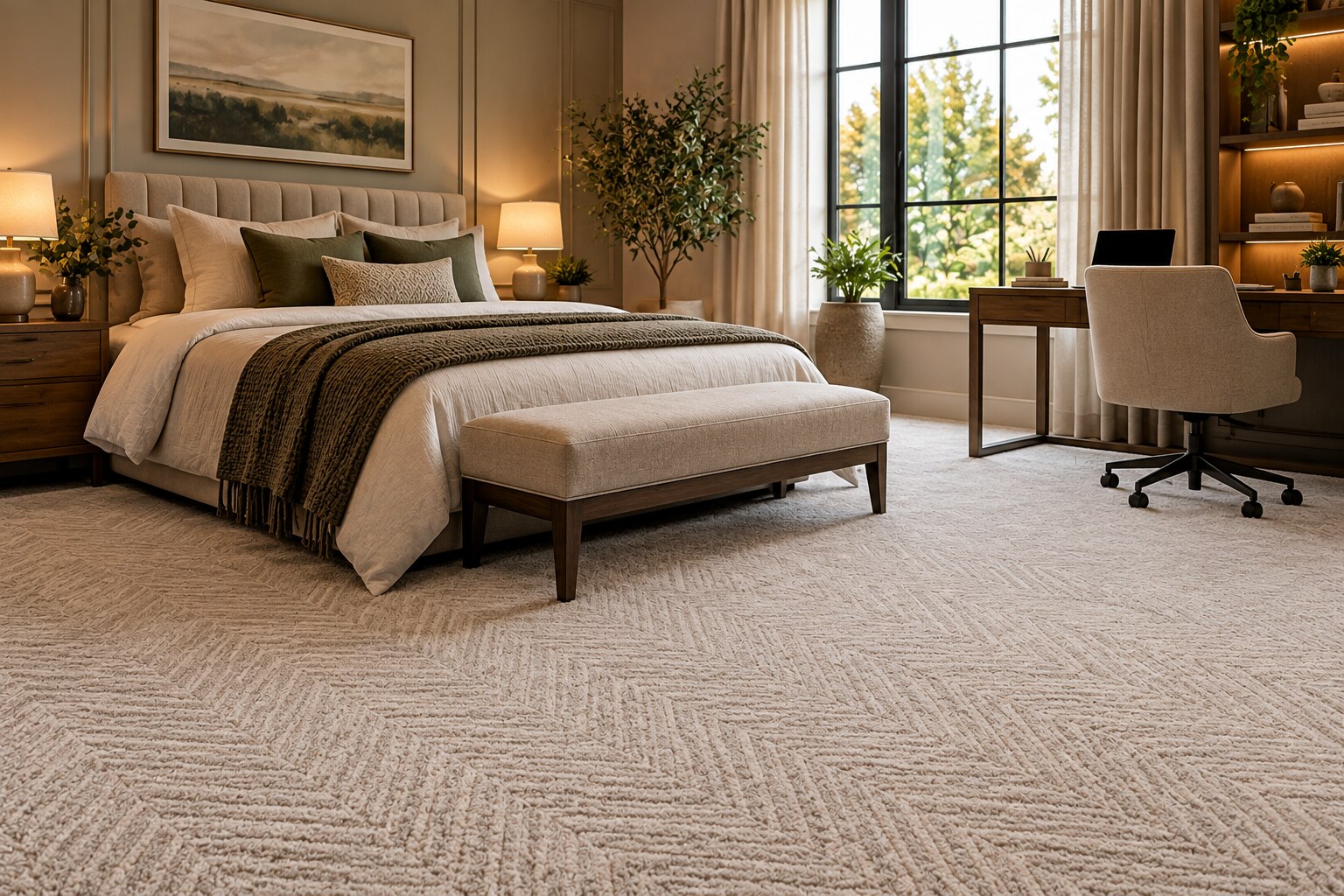
| Guest rooms | Class 31 or 32 | Guest room carpet faces lighter traffic, so prioritise comfort, stain concealment and easy replacement over maximum wear resistance. |
| Reception areas | Class 32 or 33 | Use the higher class for queues, luggage trolleys and entrance dirt; select a pattern that disguises tracking. |
| Restaurants | Class 32 or 33 | Allow for chair movement, food spills and frequent cleaning; confirm stain treatment and avoid surfaces that show crushing. |
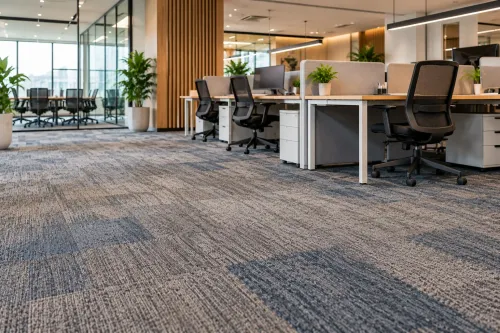
| Open-plan offices | Class 32 or 33 | Office carpet must withstand desk chairs and repeated caster movement; state approved caster types, load limits and whether chair mats are required. |
| Private offices and conference rooms | Class 31 or 32 | Match the class to chair movement, visitor frequency and furniture rearrangement. |
| Stairways | Class 33 | Use a low-profile, secure surface with firm edge detailing; concentrated footfall wears stair nosings and treads quickly. |
For commercial carpet selection, nylon usually resists chair wear better than polypropylene, while polypropylene suits moisture-prone areas but crushes more readily. Confirm the fire classification required locally; ASTM E648 Class I is at least 0.45 W/cm².
Compare Carpet Construction, Fibre and Performance Specifications
Choose construction by the failure you need to prevent, not by face weight alone. A heavy carpet with low pile density, excessive pile height or weak tuft bind can wear sooner than a lighter, denser product.
| Construction | Performance signal | Suitable use |
|---|---|---|
| Loop pile | Low profile and good traffic resistance; pulled loops can run or snag | Open-plan offices and corridors where snag risk is controlled |
| Cut pile | No loop pulls, but crushing, shading and traffic lanes show sooner | Guest rooms and quieter offices; use texture or pattern to disguise wear |
| Cut-and-loop carpet | Mixed heights hide footprints, soil and minor damage | Reception areas, conference rooms and hospitality spaces |
| Tufted carpet | Common commercial construction; inspect tuft bind, backing and seam stability | Most offices and hotels when the complete specification is strong |
Compare face fibre as well. Nylon offers strong resilience and recovery from compression; polypropylene resists moisture and some stains but has lower resilience. Polyester provides colour and stain performance, while wool offers comfort and natural resilience at a higher cost.
Solution-dyed fibre suits entrances and areas needing aggressive cleaning, but confirm approved chemicals with the manufacturer.
Require an EN 1307 use class: Class 31 is light commercial, Class 32 general commercial and Class 33 heavy commercial. Also check pile density, pile height, tuft bind, backing stability, castor-chair suitability and the manufacturer’s warranty. Face weight alone proves little.
For entrances, specify outside scraping mats, absorbent interior mats and a cleaning and replacement schedule. For occupied interiors, check CRI Green Label Plus for the carpet, cushion and adhesive assembly; it addresses emissions, not durability.
Choose Broadloom or Carpet Tiles Before Planning Installation
Broadloom carpet is the stronger choice when you need a continuous visual field, controlled pattern alignment and fewer visible joints across large, uninterrupted areas. Choose it for executive offices, conference suites, hotel guest rooms or spaces where tile seams would distract from the design.
| Option | Best advantage | Main compromise |
|---|---|---|
| Broadloom carpet | Continuous appearance with fewer seams and better pattern flow | Damaged areas require cutting and re-seaming; access to floor boxes is difficult |
| Carpet tiles | Individual replacement and lift-up access to underfloor services | Seams remain visible, and edges can gap, peak or curl after poor installation |
Choose carpet tiles for offices with frequent churn, heavy entrance wear, raised-access floors or areas where spills and replacement patches are expected. State the intended layout—monolithic, quarter-turn or ashlar—on the order, because direction changes can create unwanted shading or seam lines.
Installation must wait until the building is enclosed and the permanent HVAC system is operating. Keep temperature and humidity within the carpet and adhesive manufacturers’ limits, acclimatise the materials, and follow the applicable CRI installation standard.
Before laying carpet, document concrete moisture and alkalinity using the tests specified by both manufacturers. ASTM F2170 measures in-situ relative humidity; ASTM F1869 measures moisture-vapour emission. Excess moisture can damage carpet backing, weaken adhesive and produce bubbles or open seams.
Use the specified adhesive open time and power-stretch broadloom where required. A loose fit leaves wrinkles; inadequate seam preparation leaves gaps.
Calculate Quantity and Hide Seams, Dirt and Replacement Patches
Floor area alone produces a misleading carpet quantity calculation. Measure each room, corridor and alcove separately, then plan the number of drops from the roll’s stated width. A 3.66-metre-wide roll does not cover a 4-metre room in one piece; the extra strip creates a join, waste or a different cutting plan.
Pattern repeat increases the order length because adjoining drops must be aligned. Ask the installer to calculate each drop with the repeat added, rather than multiplying room area by a percentage. Large repeats can consume substantial material at doorways, corners and irregular room ends.
Approve the layout before ordering. Check:
- Run broadloom in the dominant direction of corridors and main sightlines.
- Keep carpet seam placement away from door thresholds, queue lines and strong daylight where changing pile direction will show.
- Place joins under beds, desks or fixed furniture when access and safety permit.
- Keep every room’s cuts within the same dye lot, and record the lot number for future patches.
Choose a commercial carpet colour that disguises tracked soil without making patching obvious. A replacement cut from a different dye lot can look like a rectangle even when the colour name matches.
For carpet tiles, state the installation direction—monolithic, quarter-turn or ashlar—in the order; that decision affects both visible seams and how many tiles you need after allowing for perimeter cuts.
Turn the Selection into a Maintainable Commercial Flooring Brief
Require every supplier quotation to state the following, not leave them in a catalogue or verbal assurance:
- Product name, construction, fibre, backing, dye lot, roll or tile dimensions, and replacement availability.
- Traffic classification, castor-chair suitability, acceptable caster types, load limits, and whether chair mats are required.
- ASTM E648/NFPA 253 result: Class I means at least 0.45 W/cm²; Class II means at least 0.22 W/cm² but below 0.45 W/cm². Confirm the classification required by local building and fire regulations.
- CRI Green Label Plus status for the carpet, adhesive and cushion, with the exact products named. The label addresses emissions under its test programme; it does not prove durability or stain resistance.
- Approved adhesive, cushion, seam method, acclimatisation conditions, power-stretching requirement and installation standard.
- Cleaning products, equipment, frequencies, extraction method and warranty conditions.
A usable carpet maintenance plan begins at the entrance: remove dry grit frequently, vacuum high-soil routes, treat spills immediately and schedule professional extraction. Obtain these instructions before comparing prices, because using the wrong chemical or missing a required cleaning frequency can void the warranty.
For offices, include a stocked replacement quantity from the same dye lot. Carpet tiles simplify future repairs and floor-box access, while broadloom reduces visible seams; the quotation should identify which trade-off applies. Flooringworld can help document these requirements in a site-specific quotation rather than treating “commercial grade” as a complete specification.
Related service
WALL TO WALL CARPET Upgrade your interiors with premium wall-to-wall carpet solutions that combine comfort, style, and durability. View service → |
Frequently asked questions
How do you match commercial carpet to each area?
Classify each zone by foot traffic, wheeled loads, spills and cleaning frequency. EN 1307 Class 31 suits light commercial areas, Class 32 general commercial use and Class 33 heavy commercial use.
Which carpet construction and fibre should commercial spaces use?
Compare loop, cut and cut-and-loop construction alongside fibre type, pile density, backing, wear ratings and stain resistance. Select the specification for the zone rather than choosing on appearance alone.
Should a hotel or office choose broadloom carpet or carpet tiles?
Choose broadloom when you need a continuous visual field and can install a large area at once. Choose carpet tiles when phased installation, access to subfloor services or local replacement matters.
How should you calculate commercial carpet quantity?
Measure every room and corridor, add allowances for cutting and pattern matching, and plan seam locations away from main routes. Reserve matching tiles or carpet for future replacement patches.
What belongs in a commercial carpet flooring brief?
Record each zone’s traffic class, dimensions, carpet construction, fibre, colour, backing, installation method, seam plan, cleaning routine, warranty documents and replacement-stock requirement.