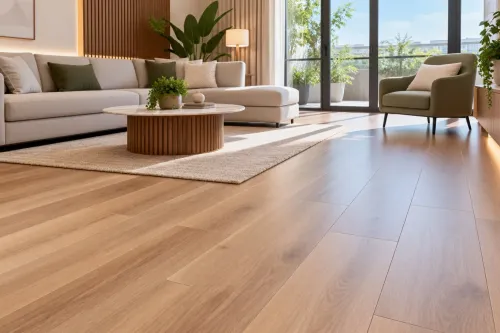


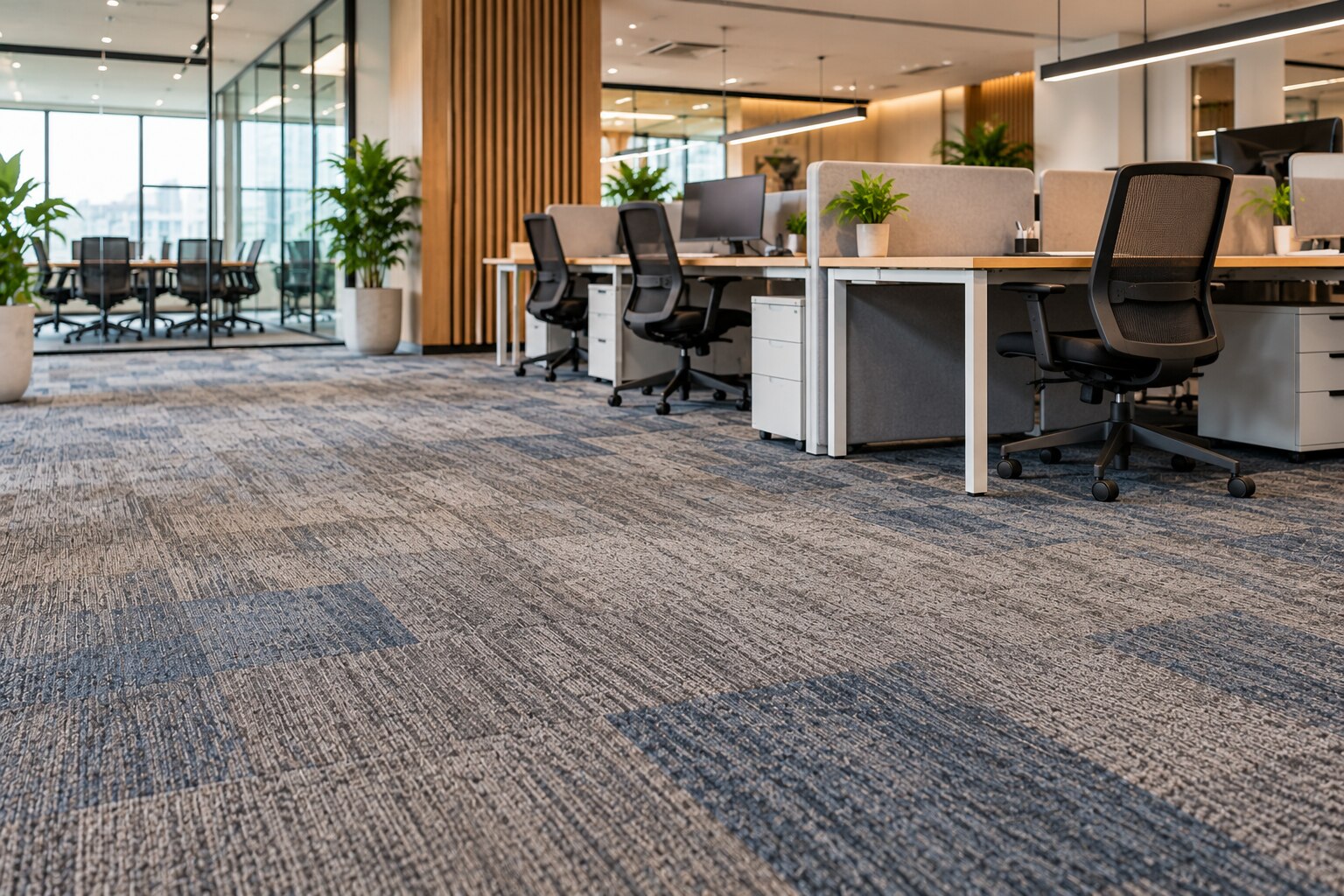
Hard floors reflect speech, footsteps and chair movement, so an office can feel noisy even when no single sound is extreme. You will learn which carpet-and-underlay features affect absorption, how to compare flooring systems, and what other surfaces must be treated before you specify a solution.
Key takeaways
- Carpet reduces reflected sound and reverberation; it does not block noise between rooms.
- Dense carpet paired with acoustic underlay improves floor-level sound absorption.
- Wall-to-wall carpet offers continuous coverage; carpet tiles simplify repairs and replacement.
- Combine carpet with ceiling, wall and workstation treatments for a quieter office.
What carpet changes about sound inside an office
Carpet improves acoustic comfort by changing what happens at the floor, not by sealing the room. Its fibres and backing provide sound absorption, so less sound bounces between the floor and other hard surfaces. That reduces reverberation and lowers reflected speech energy, making conversation feel less harsh without removing it.
Carpet also softens footfall impact noise because its surface and cushion deform under contact instead of transferring the full удар to a rigid floor. Chair movement and objects hitting the floor become less sharp, which reduces sudden distractions near workstations.
A softer underlay can strengthen this effect, but too much softness can make office chairs harder to roll.
Carpet cannot make an office soundproof. Voices and equipment noise can still pass through openings, partitions, ceilings and building services, while low-frequency traffic or mechanical noise often needs isolation elsewhere.
The Noise Reduction Coefficient, or NRC, helps compare how much sound a product absorbs in a laboratory; it does not describe speech privacy or the impact performance of the complete floor-ceiling assembly. A carpeted floor therefore improves room sound, but it cannot replace wall mass, mechanical isolation or a properly designed ceiling.
Carpet absorption is not the same as sound insulation
Carpet can reduce footfall, chair movement, dropped-object noise and reflected speech inside a room; it cannot stop voices, traffic or plant noise travelling through walls, ceilings, doors or service risers. That is sound absorption versus sound insulation: absorption controls reflections locally, while insulation blocks transmission between spaces.
The Noise Reduction Coefficient (NRC) is a laboratory average based on absorption measurements at 250, 500, 1,000 and 2,000 Hz. Use it to compare products only when the test method, mounting condition, carpet construction and underlay are equivalent. NRC does not measure speech privacy, impact-noise insulation or complete office performance.
Carpet generally reduces mid- and high-frequency reflections, not low-frequency mechanical or structure-borne noise.
| Office problem | What carpet can do | What requires construction or system measures |
|---|---|---|
| Footsteps, chair movement and dropped objects | Absorb floor reflections and soften impact noise | A tested floor assembly or resilient underlay for impact insulation |
| Voices crossing a partition | Reduce reverberation inside the source room | A sealed, heavier partition, door seals and controlled openings |
| Traffic, generators and HVAC plant | Limit reflected sound after it enters the room | Mechanical isolation, duct silencers, equipment separation and building-envelope treatment |
| Noise from the floor above | Add limited surface absorption below | A rated floor-ceiling assembly; check impact ratings separately from airborne sound ratings |
A thicker or softer underlay can improve impact performance, but excessive softness makes chairs harder to roll and can create fatigue or accessibility problems. Specify a carpet-and-cushion system tested for the intended casters, traffic and floor assembly.
Which carpet-and-underlay features affect acoustic performance
Compare the tested carpet-and-underlay assembly, not the carpet’s appearance alone. The same surface can absorb sound differently when installed over concrete, a raised floor or a lightweight floor.
| Feature | What to compare | Why it matters |
|---|---|---|
| Fibre type | Wool, nylon, polyester or blended fibre in the same construction | Fibre affects how the pile behaves, but it does not predict performance by itself. |
| Pile height | Short, medium or tall pile | A thicker pile usually provides more material for absorption than a very short, flat surface. |
| Pile density | Closely packed tufts versus an open pile | Density changes the amount of air movement through the carpet and its resistance to wear. |
| Backing construction | PVC, bitumen, polyurethane or other backing | Backing adds mass and can alter absorption, dimensional stability and impact-noise behaviour. |
| Underlay | Material, thickness and tested acoustic result | A resilient cushion usually outperforms direct installation on a hard screed. |
| Installation | Full bonding, stretched installation or loose-lay tiles | Gaps, loose edges and poorly bonded tiles create maintenance and trip problems. |
Use NRC only for like-for-like comparisons. It averages absorption at 250, 500, 1,000 and 2,000 Hz, but it does not measure speech privacy or impact insulation. Check that the laboratory method, mounting condition, carpet construction and underlay match.
For carpet tiles, compare the complete assembly rather than assuming broadloom performs better. When reviewing samples with Flooringworld, ask for the tested carpet-and-underlay specification and the installation method used in that test.
Related service
WALL TO WALL CARPET Upgrade your interiors with premium wall-to-wall carpet solutions that combine comfort, style, and durability. View service → |
Wall-to-wall carpet, carpet tiles and hard flooring compared
Full floor coverage provides a greater acoustic benefit when people cross most of the room and footfall and speech reflections occur across the floor. It replaces nearly all hard reflective area, so walking routes do not alternate between quiet carpet and noisy concrete or vinyl flooring.
Area rugs cannot cover those routes unless they are numerous and tightly fitted.
| Option | Acoustic result | Practical trade-off |
|---|---|---|
| Wall-to-wall carpet | Most consistent reduction in footfall noise and mid- and high-frequency reflections | Replacing a damaged section is difficult; the tested carpet-and-underlay assembly matters |
| Carpet tiles | Comparable to wall-to-wall carpet when backing and underlay match | Replace stained or damaged tiles locally, but gaps, loose edges and poor bonding create trip risks |
| Area rugs | Reduce reflections and impact noise only within their footprint | Leave hard reflective zones between desks, corridors and shared equipment |
| Hard flooring | Reflects more speech, footsteps and equipment noise | Easier to clean and move furniture across, but needs rugs or other treatments for comfort |
A carpet over sound-absorbing cushion will outperform the same carpet fixed directly to concrete or screed. Compare complete tested assemblies, not a free-hanging absorption rating with a glued-down installation.
Full coverage also has limits: ceilings and walls often offer more available area for reverberation control, while low-frequency plant, traffic and structural noise require isolation rather than carpet.
How to plan a quieter office around the floor
Plan the floor as one layer in a room-by-room acoustic plan, not as a cure for every noise source.
1. Map the open-plan office before choosing coverage. Mark conversation zones, printer and kitchen noise, circulation routes, glazed walls, hard ceilings and noise-sensitive rooms beside or below. Carpet will soften reflected speech and footfall, but it will not block voices travelling through partitions, doors or building services.
2. Treat the largest reflective surfaces together. Pair carpet with an acoustic ceiling, then add wall panels where speech still reflects from glazing or bare walls.
Use workstation screens between facing desks to absorb sound near its source and reduce direct speech paths; do not place them where they narrow fire routes or wheelchair turning areas.
3. Protect movement and cleaning access. Keep chair casters rolling across a firm, level surface, specify securely bonded carpet tiles, and avoid raised transitions at doorways. Divide treatment around furniture layouts rather than creating loose rugs that curl, trap dirt or interfere with wheeled equipment.
4. Plan for local repairs before installation. Carpet tiles let you replace a stained or damaged area without lifting the whole office, but keep spare tiles from the same batch and record their orientation. Provide clear access to floor boxes, desk power and service panels, or acoustic improvements will create disruption during routine maintenance.
Frequently asked questions
What does carpet change about sound inside an office?
Carpet absorbs some sound at the floor, reducing reflections between the floor and other hard surfaces. This lowers reverberation and reflected speech energy.
Does carpet provide sound insulation between offices?
No. Carpet absorption reduces reflected sound inside a room, while sound insulation limits noise passing through walls, floors, doors or ceilings.
Which carpet and underlay features affect acoustic performance?
Carpet fibre structure, backing, density and the underlay affect how much sound the floor absorbs. A suitable acoustic underlay adds further absorption beneath the carpet.
How do wall-to-wall carpet, carpet tiles and hard flooring compare acoustically?
Wall-to-wall carpet provides continuous sound-absorbing coverage. Carpet tiles offer similar coverage with easier local replacement, while hard flooring reflects more sound unless other acoustic treatments compensate.