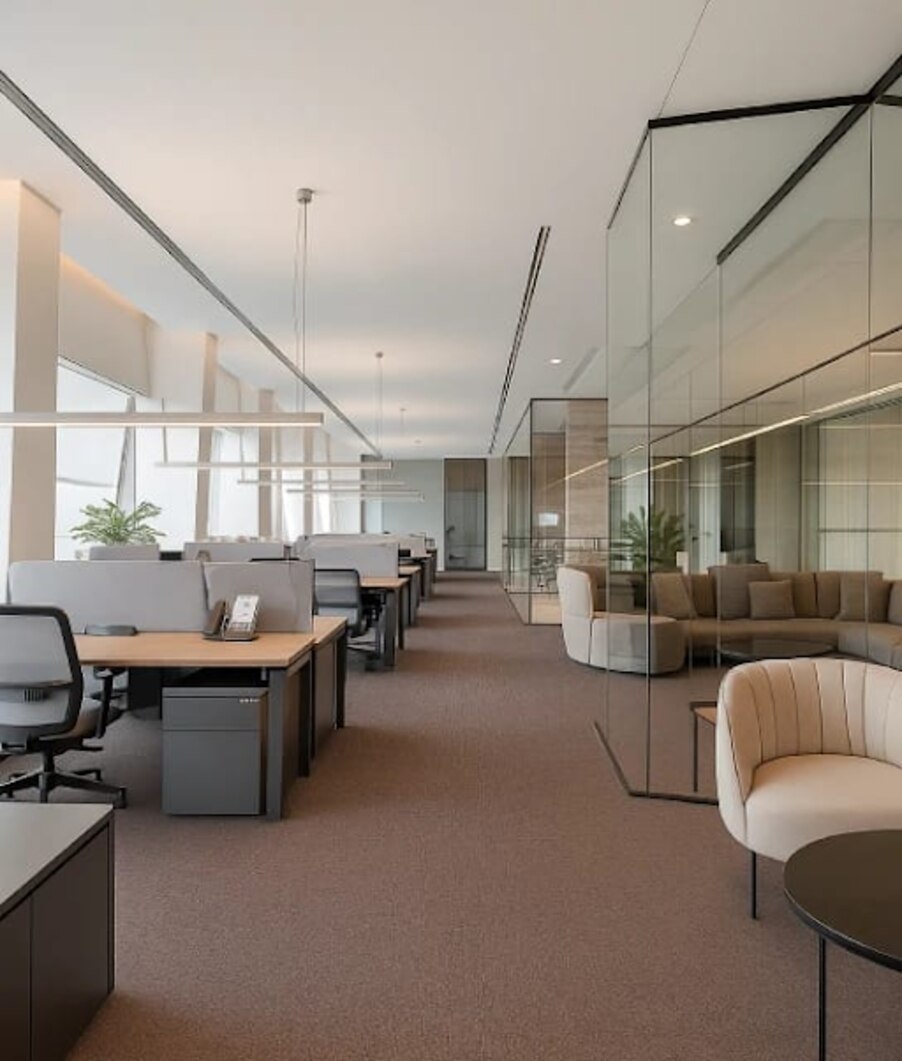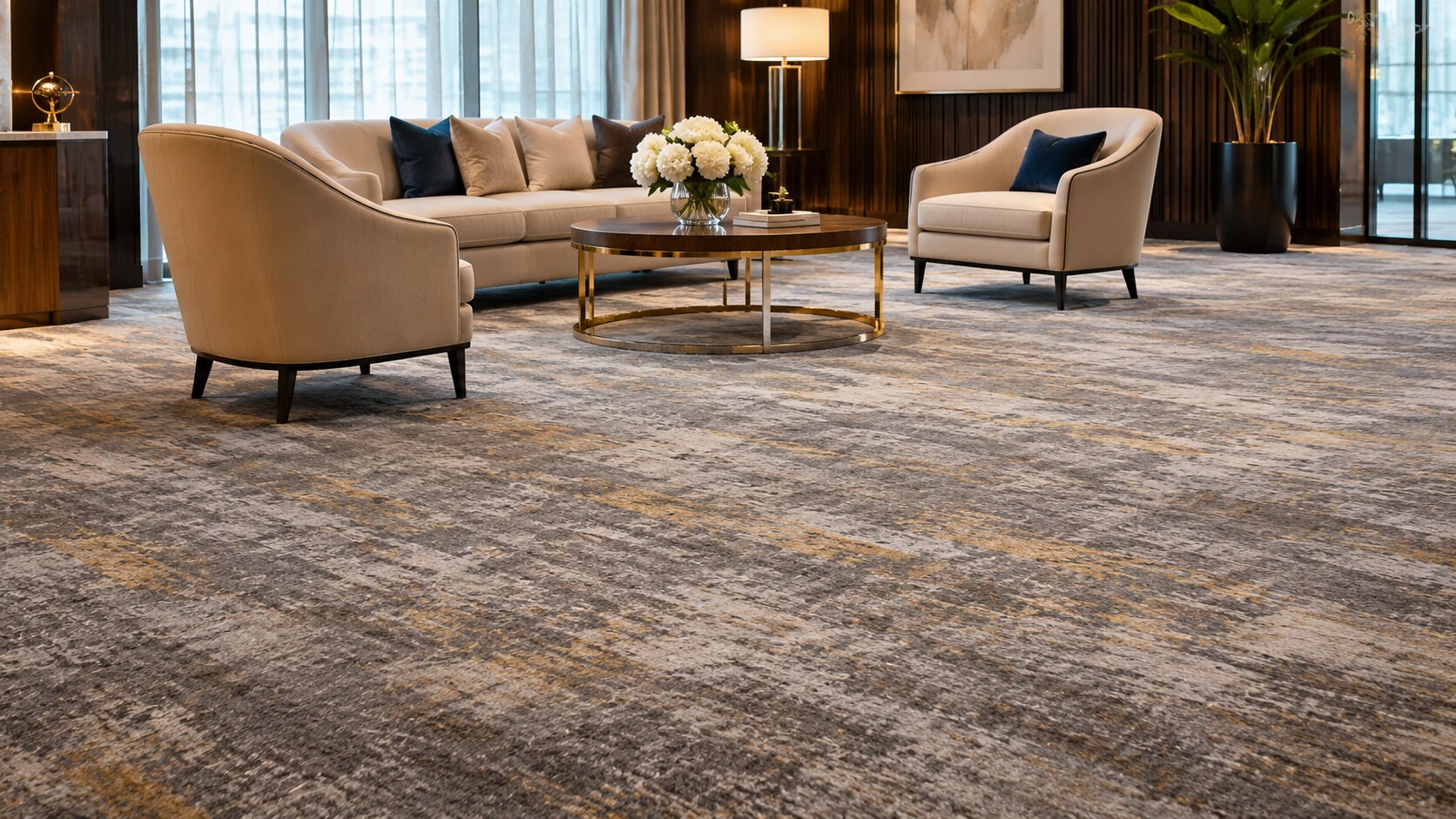


The right office carpet depends on traffic, chair movement, maintenance, installation constraints and future repairs—not colour alone. By the end, you will have a room-by-room method for comparing carpet formats, performance specifications, dealer quotations and replacement planning.
Key takeaways
- Use carpet tiles where spills, casters and layout changes are frequent.
- Request fibre, pile height, density, wear rating and backing details.
- Choose tiles for repairable flexibility; choose broadloom for a seamless finish.
- Check subfloor preparation, installation zones, seams and waste in the quote.
Match the Carpet Format to Each Commercial Area
Carpet tiles suit open-plan offices, corridors and work areas with frequent spills, chair-caster movement or changing furniture. Broadloom creates a continuous, more formal surface for reception areas, meeting rooms and private cabins. Use an area rug only to define a seating zone, soften a boardroom or add colour where full-floor Carpet Flooring is unnecessary.
| Area | Best format | Why it fits |
|---|---|---|
| Open-plan office | Carpet tiles | Replace one damaged tile without removing a large section; keep spare tiles for future repairs. |
| Corridors and circulation routes | Carpet tiles or durable broadloom | Tiles simplify local repairs, while broadloom reduces visible joints across long, uninterrupted runs. |
| Private cabins | Broadloom or carpet tiles | Broadloom gives a seamless appearance; tiles suit rooms with frequent layout changes. |
| Meeting rooms | Broadloom or carpet tiles | Choose broadloom for a polished finish and tiles when table movement or spill replacement matters. |
| Reception areas | Broadloom or an area rug | Broadloom handles continuous coverage; an area rug works when the seating zone needs definition rather than wall-to-wall flooring. |
Choose Office Carpet Flooring with at least Class 32 for general commercial use; specify Class 33 where reception desks, corridors or circulation receive heavy traffic.
Ask the dealer to calculate installation allowance, not just match the measured floor area. Broadloom needs extra material for roll width, pattern repeats, seam placement, damaged sections and future repairs. Confirm the batch or dye-lot number.
Before ordering tiles, verify the approved pressure-sensitive adhesive or tackifier. For broadloom, confirm whether the system requires direct glue-down, tack strips or cushion, because the wrong adhesive or underlay can cause seam failure and invalidate the warranty.
Request Performance Specifications, Not Just a Sample
Ask a Carpet Flooring Dealer for a written technical schedule before comparing colours or prices. A face-fibre label does not reveal how the carpet will perform under office chairs, rolling loads, seams or replacement work.
1. Identify the fibre, pile construction, pile height and density, backing type, tuft bind, dimensional stability, colourfastness and suitable-use or wear classification. These details show whether the product is designed for commercial traffic rather than light residential use.
2. State the approved installation method: direct glue-down, tack-strip stretch-in or cushion-backed installation. For carpet tiles, name the approved pressure-sensitive adhesive or tackifier; for broadloom, specify the permitted adhesive or cushion. An unsuitable substitute can cause shifting, failed seams, dimensional movement and a rejected warranty claim.
3. Request test documents for stairs, corridors, exits and other regulated areas. The certificate should identify the actual carpet construction and assembly, including underlay and adhesive, and report the tested flame-spread or critical-radiant-flux classification. “Fire resistant” alone is not a specification.
4. Compare a physical sample with an installed mock-up under the office’s actual lighting. Check the delivered dye lot, carpet direction, pile shading and proposed seam locations; catalogue colours cannot show how a large installation will appear.
5. Demand a total installed quotation covering substrate preparation, moisture testing, adhesive or cushion, removal and disposal, skirting, transitions, delivery, labour, wastage, cleaning and retained replacement tiles or roll material. Ask for the maintenance schedule, including vacuuming, spot treatment and restorative cleaning, before approving the product.
Choose Fibre, Pile and Density for the Actual Traffic
A dense, low-level loop usually handles office corridors and chair-caster traffic better than a tall plush pile. Ask the Commercial Carpet Supplier for pile construction, pile height, density and face weight; face weight alone does not predict wear.
Under ISO 10874, compare Class 31 for moderate use, Class 32 for general commercial use and Class 33 for heavy commercial use.
| Fibre | Main advantage | Limitation and best use |
|---|---|---|
| Nylon | Strong abrasion resistance, good resilience and recovery from crushing | Usually the safer choice for corridors, reception areas and rolling chairs |
| Polypropylene | Good stain resistance and lower purchase cost | Recovers poorly from crushing; reserve it for lighter office traffic |
| Polyester | Strong colour and stain performance at a lower cost | Loses appearance sooner under concentrated traffic and chair movement |
| Wool | Resilient, comfortable and naturally soil-hiding | Higher cost and more demanding maintenance; suits premium, controlled-traffic areas |
Choose loop pile where durability and a consistent appearance matter. Cut pile feels softer, but footprints and caster tracks show sooner; textured or patterned surfaces hide shading better than a plain, smooth finish.
Keep pile height modest in circulation routes. A tall pile traps more soil, resists chair movement and crushes faster, while an extremely low pile can feel harsh and expose seams or subfloor irregularities.
Ask for density figures and an installed sample before approving Office Carpet Flooring, because a dense low-level loop can outperform a heavier, less-dense plush carpet.
Compare Carpet Tiles with Broadloom on Future Flexibility
Carpet tiles usually offer the better balance for Office Carpet Flooring that must survive spills, furniture changes or future access to services. Broadloom wins on visual continuity, especially across a large, open floor, but one damaged area becomes a cutting and seaming job rather than a simple replacement.
| Format | Installation time | Waste | Access and repairability | Appearance |
|---|---|---|---|---|
| Carpet tiles | Fast to stage around occupied areas; slower across a completely empty floor | Low, because cuts can be reused in smaller areas | Lift individual tiles for access and replace damaged pieces | Grid lines can show; replacement tiles may vary by dye lot, wear and direction |
| Broadloom | Efficient across large, unobstructed rooms; requires careful roll handling and seam planning | Higher allowance for roll width, pattern repeats, room geometry and future repairs | Removing a damaged section risks visible seams and larger disruption | Most continuous, with fewer visual breaks; seams and pile shading still need mock-up approval |
Choose tiles when raised-access floors, frequent spills, churned workstations or phased refurbishment matter more than a completely seamless field. Choose broadloom when the room is stable, empty during installation and appearance takes priority.
Ask for a physical sample and an installed mock-up under the actual office lighting. Confirm the batch or dye-lot number, installation direction and retained replacement stock. For either Carpet Flooring format, compare total installed cost: preparation, moisture testing, adhesive, removal, waste, labour, transitions and future repair material—not the carpet price alone.
Audit the Dealer’s Quote, Samples and Installation Plan
A low carpet price can hide substrate repairs, wastage and future replacement problems. Before you approve a quote, require the Carpet Flooring Dealer to document exactly what will arrive, how it will be installed and what material will remain for repairs.
1. Match the quote to the specification: fibre, pile construction, backing, traffic classification, installation method, adhesive or cushion, delivery, labour, wastage, removal and disposal, substrate preparation, moisture testing, skirtings, transitions, cleaning and retained replacement stock.
2. Check the quantity calculation. For broadloom, confirm roll width, room geometry, pattern repeat, seam locations and a realistic allowance for pattern matching, damaged sections and future repairs. Ordering only the measured floor area can leave you short.
3. Keep a physical sample labelled with the batch or dye-lot number. For a large Office Carpet Flooring project, demand an installed mock-up in the actual lighting. Catalogue colours cannot show pile shading, carpet direction, daylight changes or how seams will appear.
4. Make the Commercial Carpet Supplier state whether the product is approved for direct glue-down, tack-strip installation or cushion installation. Carpet tiles usually require pressure-sensitive adhesive or manufacturer-approved tackifier; an unapproved adhesive or cushion can cause movement, seam failure and warranty disputes.
5. Before installation, have the installer test the concrete under ASTM F710 procedures, including pH and moisture evaluation. A dry-looking slab can still cause adhesive failure, odour, bubbling or backing deterioration.
Flooringworld can help you retain the dye-lot record, installation plan and spare tiles or roll sections with your project documents.
Related service
WALL TO WALL CARPET Upgrade your interiors with premium wall-to-wall carpet solutions that combine comfort, style, and durability. View service → |
Frequently asked questions
Which carpet format suits different commercial areas?
Use carpet tiles for open-plan offices, corridors and work areas with frequent spills or changing furniture. Use broadloom for reception areas, meeting rooms and private cabins. Use area rugs to define seating zones without carpeting the entire floor.
What performance specifications should you request from a Carpet Flooring Dealer?
Ask for the fibre type, pile construction, pile height, density, backing, wear classification, fire-performance documentation, warranty terms and cleaning instructions. A sample alone cannot show how the carpet will perform under office traffic.
How do fibre, pile and density affect office carpet performance?
Select fibre and pile construction for the traffic and maintenance routine. Short, dense pile is easier to move office chairs across and clean, while a softer or taller pile suits lower-traffic areas where comfort matters more.
Should you choose carpet tiles or broadloom for an office?
Choose carpet tiles when you need local replacement, phased installation or future layout flexibility. Choose broadloom when you want fewer visible joins and a continuous, formal appearance. Compare waste, seam placement, access requirements and replacement plans.